Annual Intake
100 students
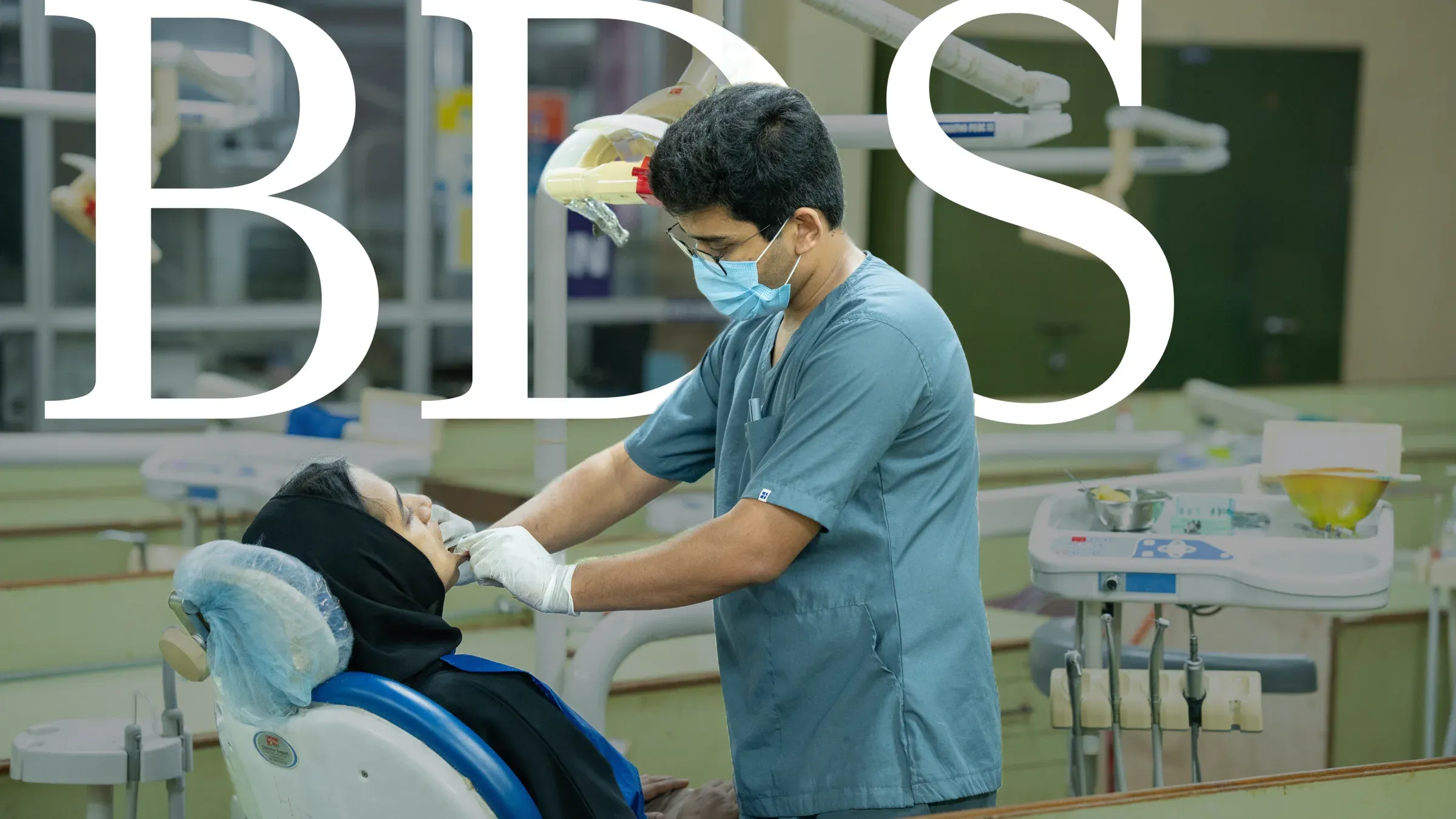
The undergraduate BDS programme introduces students to dental sciences, preclinical training, clinical practice, public health, and professional conduct.
Content emphasizes clinical exposure, department-led training, library support, community camps, and preparation for internship and professional practice.
Annual Intake
100 students
Course Duration
(4+1) 5 Years
Admission Procedure
Through National Eligibility and Entrance Test (NEET) conducted by National Testing Agency (NTA).
Entry Qualification
Applicants must meet all of the following requirements:
Course Outcomes
Have adequate knowledge of the scientific foundations on which dentistry is based and good understanding of various relevant scientific methods, principles of biological functions and should be able to evaluate and analyse scientifically various established facts and data.
Have adequate knowledge of the development, structure and function of the teeth, mouth and jaws and associated tissues both in health and disease and their relationship and effect on general-state of health and also the bearing on physical and social well-being of the patient.
Have adequate knowledge of clinical disciplines and methods, which provide a coherent picture of anomalies, lesions and diseases of the teeth, mouth and jaws and preventive, diagnostic and therapeutic aspects of dentistry.
Have adequate clinical experience required for general dental practice.
Develop adequate knowledge of biological function and behaviour of persons in health and sickness as well as the influence of the natural and social environment on the state of health so far as it affects dentistry.
Develop skill to diagnose and manage various common dental problems encountered in general dental practice, keeping in mind the expectations and the right of the society to receive the best possible treatment available wherever possible.
Acquire skill to prevent and manage complications if encountered while carrying out various dental surgical and other procedures.
Possess skill to carry out required investigative procedures and ability to interpret laboratory findings.
Promote oral health and help to prevent oral diseases wherever possible.
Competent in control of pain and anxiety during dental treatment.
Willing attitude to apply current knowledge of dentistry in the best interest of the patients and the community.
Maintain a high standard of professional ethics and conduct and apply these in all aspects of professional life.
Seek to improve awareness and provide possible solutions for oral health problems and needs throughout the community.
Develop the attitude of willingness to participate in the continuing education programmes to update knowledge and professional skills from time to time.
To help and to participate in the implementation of national health programmes.
ICLO
These undergraduate course learning outcomes are imported from the legacy ICLO page and grouped by department for the BDS programme.
To educate the students about aetiology and pathophysiology of common restorative situations such as carious, noncarious, and traumatic disease of teeth and train them to diagnose and manage the same, which will help them to provide quality restorative treatment.
To develop adequate knowledge of pulpal pathology and periapical disease and skill to diagnose and manage contemporary endodontic diseases using simple endodontic procedures.
To gain knowledge about aesthetic restorative material and translate the same to patient’s needs and function.
To provide all restorative as well as endodontic treatment procedures with high standard of professional ethics and conduct, which will contribute to the oral health and general well-being of the individual and community.
To train the student, so as a graduate, he or she will exhibit excellent professional behaviour, basic skills to achieve range of dental procedures preoperatively and post operatively with almost care, in general dental practice independently with consistency and accuracy.
To update the knowledge and professional skills from time to time through CDE programmes by lifelong learning in the field of restorative dentistry and endodontics.
To have adequate knowledge of general properties and manipulation of various dental materials used in Prosthodontics.
To have adequate knowledge of structure and function of the teeth, mouth and jaws and associated tissues and use that knowledge in restoring the lost structure and functions of the stomatognathic system.
To have adequate clinical experience of various techniques used for restoring the lost teeth and the associated oral structures.
To develop skills to examine geriatric patients and interpret necessary investigation results for the purpose of diagnosis and treatment planning.
To adopt ethical principles in all Prosthodontic practice.
Seek to improve awareness and provide Prosthodontic practice throughout the community.
To apply knowledge gained in related medical subjects in the management of patients with oral surgical problems.
To have adequate knowledge and understanding of etiology, pathophysiology, investigation, diagnosis, and treatment planning of various common oral and maxillofacial surgical problems, both minor and major in nature.
To have adequate knowledge regarding sterilization of instruments, personal hygiene and infection control, prevention of cross infection, and safe disposal of hospital waste.
To gain knowledge regarding diagnosis, understand the principles of surgical treatment of various oral and maxillofacial disorders and conditions, and decide when referral to an oral surgical specialist is required.
To acquire adequate skill to perform extraction of teeth under local anesthesia and minor oral surgical procedures like frenectomy, alveoloplasty, biopsy, and related procedures.
To provide primary care and manage medical emergencies in the dental office.
To communicate efficiently with patients regarding perioperative instructions, ethical issues, and related care expectations.
To have a comprehensive understanding of the concepts and definitions pertaining to health, disease, oral health and oral diseases, public health and dental public health, and prevention of disease and promotion of health and oral health at a community level, including the role of environment and nutrition on health.
To have adequate knowledge about various preventive measures employed for the prevention of oral diseases and skills pertaining to the same.
To have an understanding of epidemiology, oral epidemiology, and its role in prevention of common oral diseases.
To have knowledge of measurement of various oral diseases and develop adequate skill set to perform the same on patients.
To know basic concepts of health research methodology and biostatistics.
To understand the principles of code of ethics and code of conduct as per the council guidelines and the Dentist Act and to implement them in practice.
Educate and create awareness through self-prepared IEC material regarding promotion of oral health and prevention of oral disease for the betterment of the community.
To understand the concepts of primary health care and its role in implementing national health programs.
To understand the etiology, pathophysiology, principles of diagnosis, and management of common disorders of the orofacial region.
To list differential diagnoses, identify necessary investigations, and frame treatment accordingly.
To develop adequate communication skills and ability to explain the disease process to the patient and obtain informed consent from the patient.
To examine oral and paraoral structures, understand the influence of systemic conditions on oral health, and identify precautions required during dental procedures.
To know the advantages and disadvantages of ionizing and non-ionizing radiations and their applications in dentistry.
To understand the techniques, advantages, disadvantages, and applications of various imaging modalities in diagnosing diseases of the oromaxillofacial region.
To have adequate knowledge about the ill effects of radiation at cellular, tissue, and organ levels and the precautions to be undertaken by the operator as well as patients.
To have adequate knowledge regarding sterilization of instruments, personal hygiene and infection control, and prevention of cross infection during clinical and radiographic examination.
To apply knowledge of developmental disturbances affecting hard and soft tissues of the orofacial region, physical and chemical injuries of teeth and soft tissues, dental caries, and pulpo-periapical diseases for clinical application and identification.
To understand the epidemiology, etiopathogenesis, investigations, and presentation of benign and malignant tumours of epithelial, connective tissue, and salivary gland origin and acquire skills of preventive care, diagnosis, and management.
To apply knowledge of microbiology of bacterial, viral, and fungal diseases affecting the oral cavity to achieve clinical and laboratory diagnostic skills.
To understand and analyze basic principles of forensic dentistry with application to mass disasters, age estimation, and DNA analysis.
To apply knowledge regarding selection, interpretation, and evaluation of clinical and laboratory investigations such as biopsy, cytology, and haematology.
To understand diseases of immunologic origin and haematological, dermatological, and bone diseases with oral manifestations in order to develop skills of diagnosis and management.
To understand etiopathogenesis, presentation, and treatment aspects of odontogenic cysts and tumours to acquire skills of clinical and laboratory diagnosis.
To understand the basic concepts of growth and development of facial and jaw bones, facial muscles including muscles of mastication, and application of the same in diagnosing abnormal conditions such as malocclusion of the teeth, prognathism, retrognathism, and cleft lip and palate of both jaws.
To be competent enough to gauge the growth potential of the patient and plan the appropriate mode of treatment for the age and clinical presentation of the malocclusion.
To identify normal variations from abnormal presentations of occlusion in the oral cavity, counsel the patient appropriately, and differentiate between need for comprehensive orthodontic care and limited intervention for correcting developing malocclusion.
To have clarity in identifying the various types of malocclusion and also ease in communicating about the same to a specialist while referring the patient.
To be competent in fabrication and activation of certain removable appliances for correction of minor malocclusions.
To have adequate knowledge regarding the various materials used in fabrication of orthodontic appliances and their properties.
To develop a high sense of morality and adopt ethical principles in all aspects of practice.
Describe the anatomical, morphological, and histological features of the healthy and diseased periodontium and its functional aspects.
Describe and explain the etiopathogenesis of periodontal and peri-implant diseases and conditions.
To understand the basic etiology of periodontal disease so as to enable its prevention.
Apply the appropriate diagnostic technique to diagnose periodontal disease.
To acquire technical knowledge and various skills of periodontal instrumentation to create, improve, and achieve periodontal disease-free condition in patients.
Identify, plan, and execute non-surgical and surgical periodontal treatment procedures based on current scientific knowledge and evidence to treat systematically healthy and medically compromised patients.
Analyse the role of interdisciplinary approaches in periodontal and implant therapy.
Create a sense of social responsibility and capability to deliver periodontal health care to underprivileged sections of society.
Have adequate knowledge of the scientific foundations on which dentistry is based and good understanding of various relevant scientific methods, principles of biological functions, and the ability to evaluate and analyse scientifically various established facts and data.
Have adequate knowledge of the development, structure and function of the teeth, mouth and jaws and associated tissues both in health and disease and their relationship and effect on general-state of health and also the bearing on physical and social well-being of the patient.
Have adequate knowledge of clinical disciplines and methods, which provide a coherent picture of anomalies, lesions and diseases of the teeth, mouth and jaws and preventive, diagnostic and therapeutic aspects of dentistry.
Have adequate clinical experience required for general dental practice.
Develop adequate knowledge of biological function and behaviour of persons in health and sickness as well as the influence of the natural and social environment on the state of health so far as it affects dentistry.
Develop skill to diagnose and manage various common dental problems encountered in general dental practice, keeping in mind the expectations and the right of society to receive the best possible treatment available wherever possible.
Acquire skill to prevent and manage complications if encountered while carrying out various dental surgical and other procedures.
Possess skill to carry out required investigative procedures and ability to interpret laboratory findings.
Promote oral health and help to prevent oral diseases wherever possible.
Competent in control of pain and anxiety during dental treatment.
Willing attitude to apply current knowledge of dentistry in the best interest of the patients and the community.
Maintain a high standard of professional ethics and conduct and apply these in all aspects of professional life.
Seek to improve awareness and provide possible solutions for oral health problems and needs throughout the community.
Develop the attitude of willingness to participate in continuing education programmes to update knowledge and professional skills from time to time.
To help and to participate in the implementation of national health programmes.